
Allegheny Valley Expressway
Alexander H. Lindsay Highway
Allegheny Valley Expressway
Alexander H. Lindsay Highway
In 1910, when there were hardly enough cars to warrant a high-capacity highway, a Pittsburgh transportation plan gave birth to this expressway. The plan recommended widening and paving East Ohio Street from the North Side through Millvale, Etna, Sharpsburg, and Aspinwall. Work did not begin until 1921, which involved moving Saint Nicholas Roman Catholic Church farther back onto a new foundation. In 1939, another transportation plan recommended construction of the Etna-Sharpsburg Bypass to "urban freeway standards." It would not open to traffic until 1957, which was the same year that construction began from East Ohio Street to Blawnox.
In 1963, this section opened to traffic from PA 8 north to the Highland Park Bridge interchange and the following year to Blawnox.
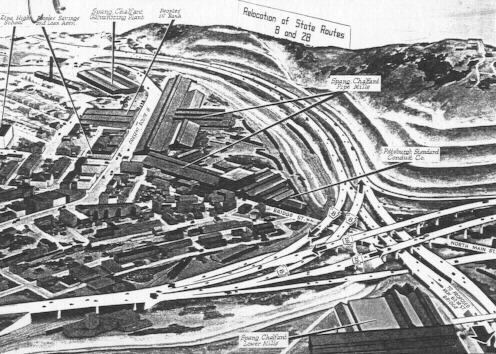
Drawing of proposed PA 28/PA 8 interchange in Etna from 1952.
(Paul Slantis)
Also in 1963, the Pittsburgh Area Transportation Plan recommended upgrading PA 28 and then PA 8, to a six-lane, limited-access highway starting 2,200 feet west of the 31st Street Bridge and ending at the 40th Street Bridge. Full interchanges would be constructed at both bridges; however, this recommendation was not carried out. It also laid out a plan that would turn PA 28 into an expressway from Pittsburgh to Brookville, this too was not carried out.
In 1968, construction began on the section from Blawnox to PA 910. The expressway was proposed from that point to the Butler County line. Construction also began on the section from Slate Lick to near Center Hill in the same year. In 1969, construction commenced on the section from PA 910 to Exit 12 and from Exit 16 to PA 356 and the Armstrong County line.
The start of the 1970s saw the construction extend from Exit 16 all the way to a new expressway alignment for US 422, also under construction, near West Kittanning. In 1971, construction commenced on the section from Exit 15 to Exit 16. In 1972, the expressway opened to traffic from Blawnox to PA 910 and from Exit 15 to US 422. However, PA 28's designation was not placed on the section from Exit 15 to Exit 16. The following year, the expressway opened from PA 910 to Exit 12. In 1975, construction commenced on the section from Exit 12 to north of Tarentum; and during the following year, the construction was extended to Exit 15. In 1978, the PA 28 designation was routed onto the newly opened highway from Exit 11 to Exit 12 and from Exit 15 to Exit 16. The PA 28 designation still followed Freeport Road to connect between Exit 12 and Exit 15.
In 1980, the expressway opened from Exit 12 to Exit 13 and that designation was moved onto this section. In 1984, a "Priority Highway System Plan" was proposed by the Southwestern Regional Planning Commission. It called for building an interchange "with Route 28 depressed below the 31st Street Bridge," and the permanent closing of Rialto Street. However, this plan was ignored just as it had been when first proposed in 1963. Even with the recommendation being turned down, it was time to celebrate the opening of the final section between Exit 13 and Exit 15 in 1985.
The first section of the expressway to see a rehabilitation was the infamous "death stretch" that extended from Millvale to Etna. Statistics showed that this section saw 169 accidents occurred from 1982 through 1987. Ninety-six of them involved injuries and four involved one or more fatalities. Construction began on September 6, 1988, and involved blasting 600,000 cubic yards of rock from the hillside that parallels the highway to reduce slides, widening the lanes to 12 feet each, adding 10-foot-wide shoulders, adding should pull-off areas such as on the Parkway East, and placing a Jersey barrier in the middle of the four foot median. The Etna interchange received new lights and signage. The $14.4 million project that required four lanes of traffic to squeeze into two finally came to an end December 7, 1990, due to rain hampering construction. Glare screen was erected on the Jersey barrier in 1991 to cut down on the effects of headlights from oncoming traffic. One final touch to this section was the addition of lighting. A little unconventional due to the placement in the median instead of the outside due to the narrow right-of-way, the lights came online in 1995. The conduit and foundations had been installed during the rehabilitation project. The standards were not installed then because of financial limitations and uncertainty over who would pay for the electric bill.
The 1994 Long Range Transportation Plan proposed widening the highway to 54 feet between Troy Hill Road and the 40th Street Bridge. State representative Don Walko commented on the lackluster performance of accomplishing this task by saying, "It's a failure of leadership going back many years. By completing other parts of the expressway northeast of the city and the interstates [I-279 and I-579] without dealing with tough issues on Route 28, we've created the missing link, a terrible bottleneck."
With all of the improvements there remains a two-mile section from the Heinz plant to the 40th Street Bridge which is the source of indigestion for many drivers, earning the name "missing link." If PennDOT and the politicians do not work together this time to get the project completed, engineers warn that traffic around the 31st Street Bridge will increase to 90,000 vehicles a day. Speed will drop to an incredible one mile an hour by 2020, which is a snail's pace by any urban standard.
Many people ask, "So what is taking forever to get this done?" The answer to that question is answered by Troy Hill Citizens, Inc. chair Cecelia Gavran. "Every time a politician comes up with another priority, money set aside for Route 28 goes somewhere else. We don't have a [Kevin] McClatchy or a [Dan] Rooney to help us. It's not what you know, it's who you know."
If anyone knows the value of this project, it is the residents who call Troy Hill home. The neighborhood sits on a hilltop across from the PA 28/31st Street Bridge intersection. It is the confluence where too much traffic and too little "green time" to go around on the signals causes 60,000 to 70,000 vehicles to idle a day at the intersection. Gavran went on to say, "The bureaucrats say 'stadium' and one year later we see a stadium going up. They re-examine and re-examine Route 28, but nothing gets done. It's a project that politicians kick around. Now they tell us we'll see action within three years. If we do, I'll eat a copy of the Sunday P-G."
A cardboard box filled with paperwork at the PennDOT District 11 office in Bridgeville leads Gavran to believe she will never see construction crews rebuilding PA 28. While there have been plans on the drawing board in the past, nothing has been done with them. PennDOT officials say that plans are on track to widen PA 28 and replace the signalized intersections at the 31st Street and 40th Street Bridges with grade-separated interchanges.
Other characteristics of the highway are narrow lanes, speeding, congestion, no shoulders, and poor lighting, which resemble the infamous "death stretch" from Millvale to Etna where 26 fatal accidents occurred in as many years. In the section under study, there have been 198 accidents between 1991 and 1995, which is more than double the state average. Out of those 198, five resulted in fatalities.
Bill Gibson, the PennDOT engineer overseeing the PA 28 progress, provides hope that the project will be completed this time around. "We're in step six of a ten-step, federally mandated process leading to project approval," said Gibson. "We're working in a very tight corridor, with the river and the railroad on one side, the hillside on the other side and numerous historical, environmental and relocation questions to address." The $110 million project included the following aspects:
Work was projected to begin late in 2004, and consisted of nine phases in order to maintain two lanes of traffic in both directions. The new expressway would have opened in mid-2009, but the plan was shelved.
A major project that got underway in 2001 was the resurfacing of the highway between Exit 6 and Exit 10. The $13 million project started on March 12, 2001, and entailed patching potholes and laying new concrete. The first rush hour had traffic crawling along at five to ten miles an hour, with backups from two miles south of the Highland Park Bridge to R.I.D.C Park. Some drivers honked their horns and banged on steering wheels. One driver even threw an apple core at an orange construction barrel. The $12.5 million project concluded on September 20, 2001.
Another project that has been going on at the same time is the reconstruction of the PA 28/PA 8 interchange. When originally built, the overpasses for the Allegheny Valley Expressway were built for only one lane of travel. On August 16, 1999, the off-ramp to PA 8 northbound from PA 28 southbound was closed to rebuild it for a total of $4.7 million. The ramp was lengthened and the hillside next to it was excavated to lessen the threat of falling rocks and reopened on January 11, 2000.
The next step of the project was the demolition of the PA 28 southbound overpass and the widening the support pillars for a two-lane wide ramp which started on April 10, 2001, was scheduled to be completed by Thanksgiving 2001. However, the company supplying the steel for the bridge deck went bankrupt and forced the contractor to find another source. The new $11.5 million southbound bridge opened to traffic on December 10, 2001.
Since Saint Nicholas Church is a major stumbling block for upgrading East Ohio Street to an expressway, new plans were laid out on July 14, 2003. The new PA 28 would be an elevated, six-lane expressway about 30 feet above the current alignment. A modification to this plan would rebuild the current roadway, impose a speed limit of 40 MPH, and give the church a five-foot-wide sidewalk in the front. Both plans would include diamond interchanges at the 31st Street and 40th Street Bridges. "If the 31st Street and 40th Street bridges weren't there, this would be a piece of cake," PennDOT Planning Engineer Todd Kravits said. Price tag for this project would range from $160 million to $200 million and would not start before 2008. A separate project to eliminate traffic lights between Chestnut and East Streets is not factored into this estimate. Both plans have the same guidelines:
His plan had the northbound lanes being built over the Norfolk Southern Railroad tracks, which parallel East Ohio Street, and retaining a section of the street for local access. Dr. White said, "PennDOT's bulldozer solution does not make sense. The air rights over the tracks present a handsome opportunity for an elevated highway that solves all of the problems of Route 28 without an ugly, two-mile retaining wall, undercutting foundations and taking the church." PennDOT engineers said of the proposal that "bubbling out" the northbound lanes where he suggested would tack on an additional $40 million.
Rock falls are still a problem for the expressway between the RIDC Park and Harmar interchanges. On July 24, 2003, an estimated 400 tons of rock and debris fell from the infamous cliff and onto PA 28, causing PennDOT to reduce the roadway to one lane southbound. The only thing that can be done is create a "drop zone," where it can fall safely to the ground. Other proposals, such as installing chain-link fencing to hold back the debris, has been dismissed as impractical or too expensive.
The next chapter in the saga of the PA 8 interchange reconstruction began on April 26, 2004. Just as commuters were getting used to not seeing construction on the expressway, PennDOT continued its improvements. The through lanes of the Allegheny Valley Expressway were rebuilt and the ramp from PA 8 south was realigned. Before that began, a water line had to be relocated and a 1,000-foot-long retaining wall built below the PA 28 grade. The $26.5 million project finished on March 17, 2005. The third phase of work began on June 7, 2009 which consisted of demolishing the old northbound bridge and replacing it with a modern two-lane bridge. It opened to one lane traffic on October 27, 2009 and opened fully a month later on November 25 drawing to a close the $22.5 million project. The fifth and final $27.2 million phase began on March 15, 2010, and consisted of interchange and roadway reconstruction, bridge replacement, bridge rehabilitation, wall construction, approach roadway widening, drainage, guide rail, concrete barrier, curb, landscaping, highway lighting, signing and pavement markings, signals, and improvements between Exit 4 and Exit 5. The majority of work was completed on December 3, 2010 when two-lane northbound traffic resumed, but minor work continued. On March 1, 2012, PennDOT announced that it won the 2012 Diamond Award Certificate for Engineering Excellence in Transportation from the American Council of Engineering Companies of Pennsylvania (ACEC/PA). See the PA 28/PA 8 Interchange Reconstruction page for a recap of the project.
In the never ending saga of what to do with the at-grade section of East Ohio Street, more alternatives are announced on June 11, 2004. The new Alternate 6M was introduced, which incorporated an urban-type boulevard at the North Side end and limited-access features at the 31st and 40th Street Bridges in the form of interchanges and ten foot shoulders. Rialto Street would stay but Millvale Industrial Park would go, but Millvale would get better access and a riverfront park. Twenty-four businesses and 95 residences would be acquired, eight historic properties including the embattled Saint Nicholas Church would have to be mitigated, and approximately 2,700 feet of Norfolk Southern Railway track would be relocated. Alternative 6 would avoid the church and reduce the number of high retaining walls which would be textured to look like brick or stone, but only provide 2 1/2-foot-wide shoulders and a 30 MPH speed limit. The final plan, Alternative 2, would eliminate the church and require retaining walls up to 65 feet high. However, 10-foot-wide shoulders, interchanges at the two bridges, and provide a speed limit of 45 MPH. The Alternate 6M would incorporate Alternative 6 from the Heinz Plant to Saint Nicholas Church and then transition to Alternative 2 to Millvale. PennDOT proposed an observation deck along Eggers Street in Troy Hill where homes would have to be acquired. Final design and acquisitions took place in 2008.
A new plan unveiled in 2006 called for shifting the Norfolk Southern tracks towards the Allegheny River rather than cutting into the hillside. Eighty-one residences and eight commercial properties would be displaced, but the status of the Millvale Industrial Park is still undecided. Final cost of the project would be between $120 and $130 million, $60 million less than earlier proposals, and if PennDOT can covered a $40 to $50 million funding gap, right-of-way acquisition would be completed in 2008 and construction begin a year later. The estimated length of construction would be two years. The new four-lane expressway would follow the same route as East Ohio Street with a posted speed limit of 45 MPH. An interchange would be built at the 31st Street Bridge intersection; however, northbound traffic would no longer access Rialto Street, but traffic from there could go in either direction on PA 28. A full interchange would be built at the 40th Street Bridge. A Jersey barrier would be added to separate the flow of traffic and protect pedestrians. The most favorable aspect of the project is that it will save Saint Nicholas Church, which will be accessible southbound via a ramp. Rush hours will also be reduced from an average of 14 minutes at 10 MPH over just two miles to three minutes at 40 MPH.
On February 8, 2007, the Federal Highway Administration announced a finding of no significant impact (FONSI) for the Route 28 East Ohio Street Improvement Project. The announcement meant the project had cleared environmental clearance and could move into final design and right-of-way acquisition. "This represents a significant milestone for the project," said District 11 Executive Dan Cessna. "Folks who have waited years for this project should feel assured it is now one step closer to becoming a reality." Alternative 7, which was presented in public meetings a year earlier, is the plan that would be carried through. The features would include: new interchange at the 31st Street Bridge which would allow all traffic movements at Rialto Street, two new southbound lanes at the 40th Street Bridge to avoid traffic signals there, preserve Saint Nicholas Church with access from southbound PA 28, Jersey barrier dividing opposing flows of traffic, improved bike and pedestrian access, and a 45 MPH speed limit.
Landslides aren't anything new to the southbound lanes of the expressway between Exit 10 and Exit 11, but a new location was affected on March 22, 2007. Heavy rains had caused the hillside along the southbound lanes between Exit 5 and Exit 6 to become unstable with an estimated 1,000 cubic yards of material falling onto the expressway. The northbound lanes were closed for awhile but they were quickly cleared and reopened. PennDOT hired a contractor to remove debris and create a drop zone along the shoulder to catch any addition debris, install a protective barrier, and replace damaged guide rails. The work was to conclude by morning rush hour on March 26, but the crews managed to finish a day early. Another boulder on another section of PA 28 did strike a vehicle during the morning rush hour on August 23, 2011 in Aspinwall. The driver, who had missed the exit he wanted, was looking to turn around when the boulder landed on his hood causing him to lose control. Aspinwall Volunteer Fire Department closed the southbound lane to clear the accident and other debris from both directions of the roadway, causing traffic to back up. In a $2.8 million project completed in 2008, PennDOT had installed extra-large chain-link fencing, catch basins, and reinforced the hillside with concrete on a section nearby, but not in the area where this accident occurred.
The interchange with I-279 at the southern end of the route was always a thorn in the side of drivers since it opened in 1989. For southbound drivers wanting to continue onto I-279 south, they had to exit onto East Ohio Street and travel through three traffic signals just like a certain "town of motels" in Bedford County. Construction on a ramp to provide a direct connection began on March 31, 2008 which weaves over Madison Avenue and under the Veterans Memorial Bridge ramps, and connects to the existing I-279 on-ramp from East Ohio Street that drivers have always used. The new $7.9 million ramp opened to traffic on September 25, 2008.
November 2009 marked the beginning of the end for the "death stretch" as the first contract awarded for work related to the East Ohio Street Improvement Project was awarded. The $24.8 million project includes relocating Norfolk Southern rail lines, upgrading drainage and traffic signals, utility relocation, and wall and bridge construction along PA 28 from Chestnut Street to the 40th Street Bridge. The American Recovery and Reinvestment Act-funded work began that month and lasted through May 2012. Bridge pier reconstruction at the 31st Street Bridge, also part of the project, involved closing the span on July 6, 2010 which gave commuters a reprieve from at least one signal until August 3 when the intersection was reopened.
Of course, before the new could be built, the old had to come down. Billboards and buildings on the hillside along East Ohio Street began to be removed in February 2010. Saint Nicholas Church, which has been a stumbling block to any construction, might be saved by an unusual entity. Lamar Advertising announced in December 2009 that it was set to purchase the church property, and planned to use part of the site to erect five billboards to replace the 49 that would be removed. A positive development to those trying to save the center of worship was Lamar's announcement that it was willing to share the property with an immigration museum proposed by the non-profit group Preserve Croatian Heritage. The Diocese of Pittsburgh encouraged demolition, but the agency has no intent to demolish the structure and would rather see the museum come to fruition. On July 22, 2012, an Allegheny County Court judge's ruling cleared the way for demolition, but the City of Pittsburgh's Historical Review Commission, wanting a local civic group to purchase the structure for $1, planned to fight the decision. The end of the road, no pun intended, came for the church when on November 15, 2012, the demolition plans were revealed. The structure would be demolished beginning in December with the statue in the grotto, the bells, the cornerstone, and the cross on the roof were saved and sent to Saint Nicholas Church in Millvale. A late $300,000 offer from the city's redevelopment authority was rejected by the Diocese of Pittsburgh in early January 2013 and quickly demolition began that only rubble remained by January 14.
Not only did the church cease to exist, so did the the neighborhood of which it was the center. Mala Jaska, or "little Jaska," was named for the Croatian village Jastrebarsko, or commonly called "Jaska," from where the early residents immigrated. The residents had pooled their hard-earned money to build Saint Nicholas in 1901. The south side of the neighborhood was eliminated when East Ohio Street was widened to four lanes in the 1920s, and 90 years later, the north side will succumb to the demands of traffic.
Finally, after all of the hemming and hawing, disagreements, proposals, and shelving of proposals, the East Ohio Street Improvement Project got underway. "This is THE project people in the Pittsburgh region have been waiting for," PennDOT District 11 Executive Dan Cessna said. "It's here. It's getting started. It's going to take a while. But it's going to happen. When it's done it'll be amazing." With no practical way to shut the road down for reconstruction, travel lanes would be narrowed to one northbound and two southbound for the duration of the project. Originally the first of four phases of the project was to get underway on August 23, but due to temporary traffic signals needing to be installed at the 40th Street Bridge, it was pushed back a week. The $23.5 million first phase consisted of widening and rebuilding the roadway, new drainage, concrete barriers, curb and sidewalk improvements, and new lighting, signage, and pavement markings. The initial project segment encompassed the section between the 31st Street and 40th Street Bridges and concluded in Summer 2012. The $36.4 million second phase began on August 22, 2011 and included widening and reconstruction to provide a new grade-separated interchange at the 31st Street Bridge and replacing a section of the bridge, modifications to the River Avenue Viaduct, sidewalk and wall construction, demolition, drainage, utility relocations, highway and sign lighting, sign structures, ITS installation, and other improvements between the Chestnut Street overpass and the 40th Street Bridge. The new 31st Street Bridge/Rialto Street interchange opened on November 25, 2013. The $15.4 million fourth, and final, phase began on December 17, 2013, which includes roadway widening and reconstruction, utility relocation, retaining wall construction, drainage upgrades and signing, lighting and sidewalk improvements. This segment will also include a 1,000-foot-long retaining wall where Saint Nicholas Church stood, which will be adorned with six historical images sandblasted into nine panels, three on the eastern end will depict the church. The $2.05 million wall will bend halfway through those three panels to invoke a three-dimensional feel. An octagonal, like the bases of the church's iconic onion domes, seating area will also be constructed with huge stones from the old Pennsylvania Canal (recovered during construction of Interstate 279) will serve as the benches. The barricades and barrels were removed on November 17, 2014, and for the first time since planning in the 1960s, one could travel between Pittsburgh and Kittanning without encountering a single traffic signal. Another positive effect of the project was that it only cost $106 million, 10% less than the projected $120 million.
A lone business owner along East Ohio Street was still holding out two years into the project, but William Lieberth, Sr., owner of Allegheny Auto Body, finally got his day in court after ignoring PennDOT's order to vacate by August 6, 2012. "Me and my son are historic. We are the last humans on 28. It’s very sad that we’re the last humans for 40 miles," Lieberth said. "They took everything from this highway and they took my neighborhood." PennDOT acquired his property in November 2011 through eminent domain, but he said the settlement did not equal the shop's value. Although other locations were offered, he didn't understand why his business could not stay. "They’re going around the church and around my body shop. I looked at the plans. I’m right beside the church," Lieberth said. The hearing was held September 7 where Allegheny County Judge Michael E. McCarthy ordered Mr. Lieberth to accept a settlement that Attorney Harvey Robins, his former council, and PennDOT agreed to in early August. The settlement included $245,000 plus $3,500 in interest, about half of which Lieberth had already received, and an extension of the move-out date to October 1. "There can be little real controversy in this matter that an enforceable agreement was reached and must be honored," Judge McCarthy wrote. He also ordered PennDOT to pay Mr. Robins a fee of $31,565 with the remainder of the settlement sent to Mr. Lieberth. Also in the judge's verdict was an order that the Allegheny County Sheriff's Department would evict Mr. Lieberth if he did not vacate the property by October 1. When that date arrived, so did the sheriff's deputies. "I got your check, give me your keys, we own the building and you’re going to be out of here in a couple minutes. They did give us half an hour. They did let me get my truck," Lieberth said.
Severe weather with torrential downpours hammered southwestern Pennsylvania during the last week of May 2019. So much rain fell in the evening of May 29, that it ran off from the Troy Hill neighborhood above and down the hillside along PA 28 between the 31st and 40th Street bridges, flooding the southbound roadway and causing both directions to be closed to traffic. The water was rising so fast, it threatened to spill over the top of the Jersey barrier and flood the northbound lanes. Around 6:30 PM, about 40 motorists had to be rescued from the rising waters. Unfortunately, one car with two occupants and a dog were caught in the rising water. The Pittsburgh Swift Water Rescue Team, comprised of police, firefighters, and paramedics, along with emergency responders from Millvale came to their rescue. "When we arrived, we found two occupants that were inside the vehicle," said Greg Tersine, the crew chief of the Pittsburgh Paramedic crew. "The vehicle submerged up to the level of the middle of the doors, to the doors. We were able to deploy our boats from the northbound lane of Route 28, and with our crew, we were able to extricate them safely. Two were trapped inside the vehicle and also a service animal that was inside the vehicle that we were able to rescue." It is estimated that three fee of water covered the pavement, due in part to storm drains that were clogged with debris. The northbound lanes were reopened around 8:30 PM, but PennDOT crews spent the night cleaning the southbound roadway and drains along the affected section which reopened to traffic just after 2 AM the following day.
The same thing ended up happening again just under two months later on July 11 when severe weather moved through the region once again. Flooding closed the route southbound between the 31st Street Bridge and I-279/I-579 and northbound between the 31st and 40th Street bridges, but also the Delafield Avenue exit and both directions between Exit 10 and Exit 11 in the morning. All sections reopened that afternoon except northbound between Exit 10 and Exit 11 which reopened a little before 7 PM, and the southbound lanes between those points which didn't reopen until a little after 1 AM the following day. PennDOT speculated that the source may be illegal dumping on Troy Hill, just above the expressway. Cheryl Moon-Sirianni, PennDOT’s District 11 executive, said that crews were there on July 15 to verify whether those reports were true and to check if the drainage pipes to the Allegheny River were clear. The area that kept flooding was the location of the former Millvale Industrial Park which was demolished for construction of the expressway. Part of the reconstruction project included a system of drainage ditches and inlets to capture storm water running off the hill. Moon-Sirianni speculated that more frequent cleaning of the retention ponds and drains, as well as lining the drainage ditches with larger rocks would be the solution.Work to eliminate the last remaining one lane sections of the expressway, at the Highland Park Bridge interchange, began on January 6, 2021. The $47.3 million project will not only add an additional line for PA 28 traffic, but also get rid of the tight merges for traffic entering from and exiting to the bridge. The bulk of work will take place during overnight hours and on weekends, which was music to the ears of commuters who have had to deal with construction at various points along the expressway and at various times for the past decade. The project area encompasses the roadway from just north of Millvale to the Delafield Road interchange, and includes lowering the expressway beneath the Highland Park Bridge, eliminating the dangerous merge on the bridge between northbound and southbound traffic trying to cross it, preservation of 10 small bridges, preservation of seven walls, installation of seven sound barriers, five new signs, and one culvert preservation. A point of contention in planning was the ramp from Virginia Avenue Extension. When an open house for the project was held in December 2017, residents were split on whether it should be kept or dropped from plans. PennDOT said closing the ramp outright was out of the question, and it was redesigned to prohibit traffic entering there from crossing to exit onto the bridge. The biggest challenge will come with constructing the additional lanes to facilitate traffic entering from and exiting to the bridge as crews will have to excavate into the hillside next to the southbound lanes as well as building up the area next to the northbound lanes. Improvements will also take place off the expressway such as the elimination of the ramp from Freeport Road to the Highland Park Bridge which will require a left turn at a new traffic signal to enter the bridge, another traffic signal will be installed at the ramps to/from Freeport Road near Western Avenue, and yet another will be installed where those ramps intersect the bridge traffic heading to PA 28. Construction is expected to end in 2023 and more information can be found at PennDOT.
|
In the 1963 Pittsburgh Area Transportation Plan, provisions were made to build this expressway all the way to the then proposed Interstate 80 near Brookville. Aside from the grading that took place at the former end at PA 66 at Kittanning, no other work was ever performed on this cancelled section and the plan axed in 1977. Interchanges would have been built at the following locations:
There have been reports that PennDOT is interesting in studying an extension to I-80, and it made the 2015 Long Range Transportation Plan. The Allegheny Valley Expressway Extension would be a four-lane expressway extending 17.5 miles to be financed and built by the Pennsylvania Turnpike Commission. This extension is listed under Subsequent Extension Authorizations in the Pennsylvania Turnpike section of Pennsylvania Statutes, and if built, would become PA Turnpike 28. The Armstrong County Commissioners received $250,000 from PennDOT in May 2019 to conduct a feasibility study to extend the expressway to Brookville. The money will be used to study short-, medium-, and long-term projects. "This could be a very big deal for Armstrong County — it could really open up the market here," said Commissioner Jason Renshaw. |
Links:
Allegheny
Valley Expressway Pictures
Exit Guide
PA 28
PA 28 Interchange Browser - Tim Reichard
PA 28
Junction List - Tim Reichard
PA
28 Pictures (Allegheny County) - Doug Kerr
Terminus of PA 28
- Adam Prince
 INFORMATION
 |
| Southern Terminus: | East Ohio Street in Pittsburgh |
| Northern Terminus: | US 422 in West Kittanning |
| Length: | 39.50 miles |
| National Highway System: | Entire length |
| Names: | Alexander H. Lindsay Highway Allegheny Valley Expressway East Ohio Street: East Ohio Street to Exit 3 Etna Bypass: Exit 3 to Exit 5 |
| SR Designations: | 0028 0422: West Kittanning to Kittanning |
| Counties: | Allegheny, Butler, and Armstrong |
| Multiplexed Routes: | US 422: West Kittanning to
Kittanning PA 66: Garretts Run to Green Acres |
| Former Designation: | PA 8 (1961 - 1973): East Ohio Street to PA 8 |
| Former LR Designation: | 70: East Ohio Street to Blawnox 1037: Blawnox to PA 66 |
 Belt System: |
Exit 3 to Exit 6 |
 Belt System: |
Exit 6 to Exit 8 |
| Emergency: | 911 |
 Traffic Cameras: |
East
Ohio Street Saint Nicholas Church Gardner Street 31st Street Bridge Croft Street 40th Street Bridge Millvale Etna |